
Interview with Romain De La Calle Maison Soierie St Georges
Since his childhood, Romain de la Calle, son of the founder of the Saint-Georges silk factory, grew up surrounded by looms and silk threads.
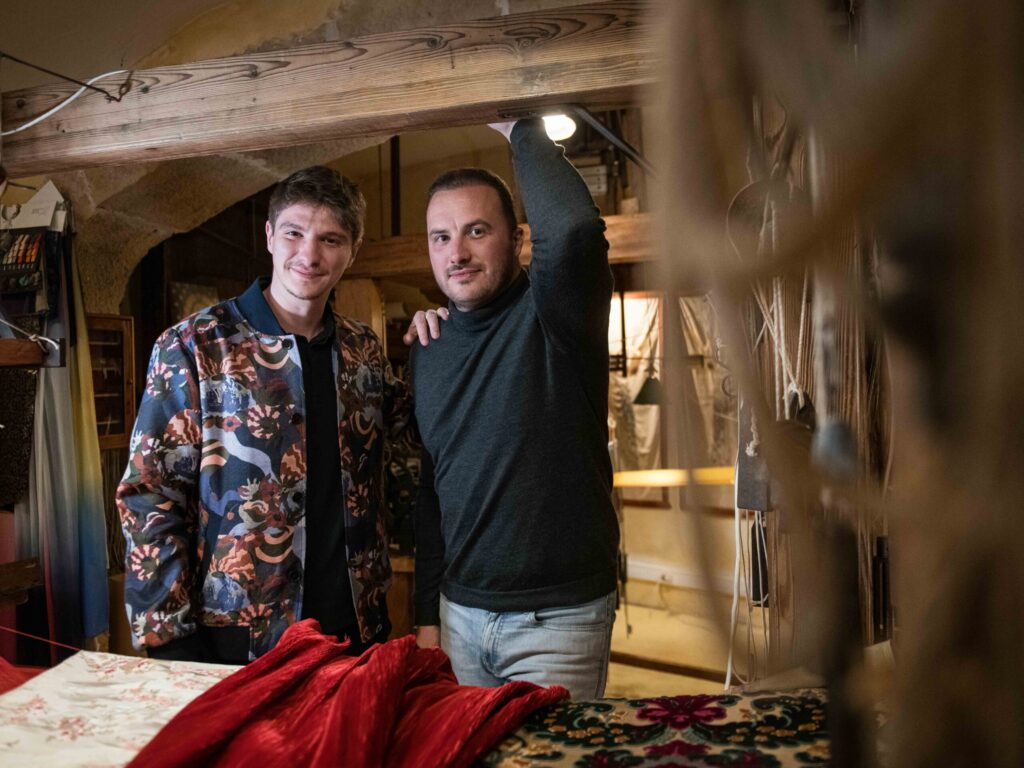
After following his own path, he joined the family workshop to continue to keep this rare and precious heritage alive. He tells us the history of the workshop, and what makes each creation unique, between tradition and modernity.
Can you introduce the Saint-Georges silk factory?
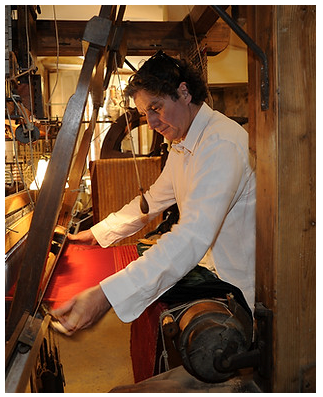
The Saint-Georges silk factory is above all a story of know-how and transmission. It all started with my father, a passionate weaver, trained in the 1970s at the Lyon weaving school, which still exists today. His career then led him to the Maison des Canuts, which he directed for nearly twenty years. In 2000, he took over a small workshop in Old Lyon, where this profession began. He developed it with new machines and collections carefully preserved as workshops closed.
Today, we continue this family adventure. I joined him ten years ago, and my brother Virgil five years ago. My father is now retired, but he still enjoys coming to help us. Together, we continue to keep traditional Lyon weaving alive.
How did the art of weaving develop in Lyon?
The history of weaving in Lyon dates back to the sixteenth century. In 1530, during the reign of King Francis I, Italian weavers were invited to Lyon to pass on their know-how. In exchange, they were exempted from taxes. These Italians settled in Old Lyon, and for nearly three centuries, the neighborhood became the heart of French weaving.
At the beginning of the nineteenth century, the textile engineer Joseph-Marie Jacquard revolutionized the craft by inventing the Jacquard mechanism, a machine using punched cards to automate patterns. Where it took three people to operate a trade, one was now enough. This invention transformed the architecture of the city of Lyon. As the Renaissance buildings of Old Lyon were not adapted to these large looms, high-ceilinged buildings, 4 metres on average, were designed at the Croix-Rousse to accommodate them.
What materials do you use and how does your know-how enhance them?
We use silk, a noble, natural and luminous material. It is appreciated by customers for its softness. We also work with precious materials such as gold and silver, in a weaving process called brocade, a Lyon weaving speciality that has almost disappeared. These exceptional pieces require several months of work, and are almost exclusively made on traditional looms. They are made slowly, at a rate of a few centimetres per day, and are intended for historical monuments or the restoration of old furniture.
How do you reconcile craftsmanship and accessibility in your creations?
Our products are made in small quantities to preserve their quality and value. With us, every piece is exclusive. A printed or woven scarf never has more than fifty copies. This contrasts with industrial production and fast fashion.
The scraps of material find a second life thanks to our collaboration with a jeweller from the Croix-Rousse, who transforms them into silk and gold-plated jewelry. Our desire is to offer the most beautiful silks at the best price. Our range, from 20 to 200 euros, allows everyone to treat themselves or a unique and durable object.
How did you combine tradition and modernity?
To enrich our collections, we call on young talents. An intern from the Beaux-Arts de Lyon recently imagined wool and silk scarves, offered at Oh my Gone, representing the monuments and maps of Lyon. These pieces highlight the city while remaining faithful to our philosophy: to bring heritage to life, to transmit know-how, and to offer creations that are out of the ordinary.
How do you keep the tradition alive?
We love to share our passion. The Saint-Georges workshop is open to the public all year round, whether for guided tours for groups, families, children or tourists. These moments allow us to tell the story of weaving in Lyon, and to give demonstrations in the workshop. Each visit invites you to dive into the Lyon of two hundred years ago, and to imagine a city where the sound of looms resounded on every street corner.

